
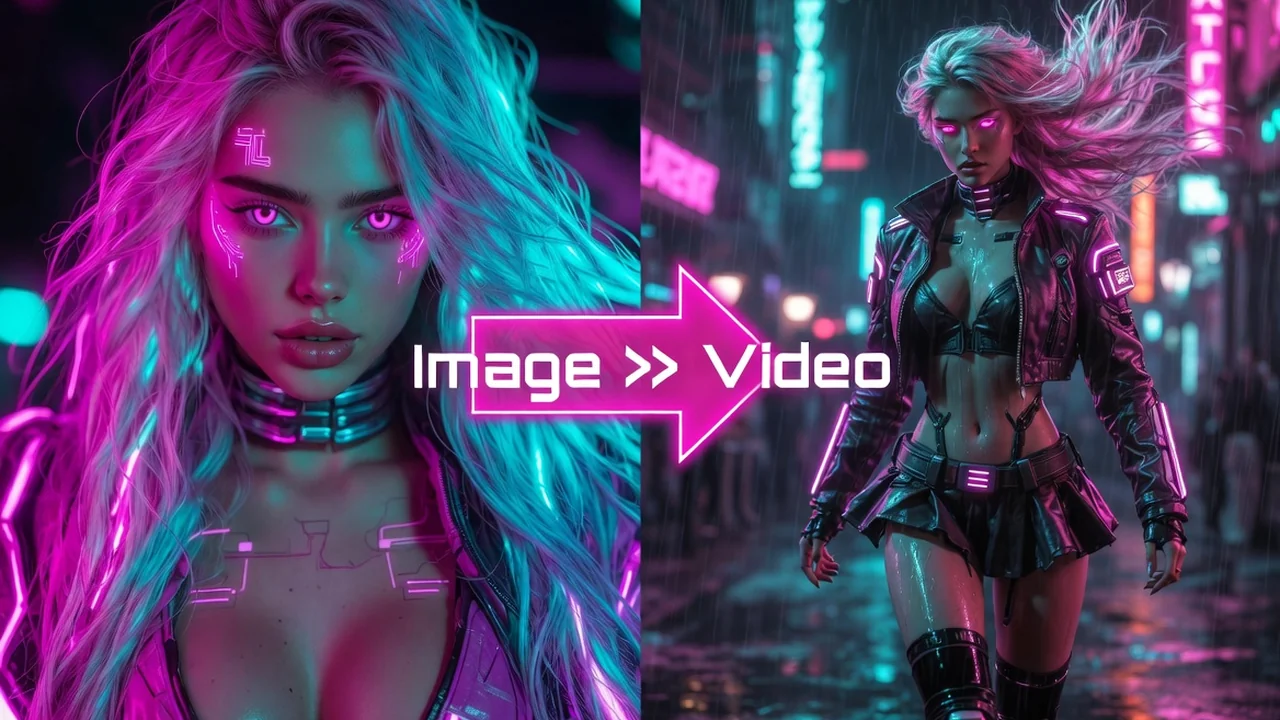
There is a moment, almost invisible, when a still image starts to move. The motion was not in the original photograph. The original photograph contained no motion. It contained a frozen instant, a single exposure of a single second, and that was the entire bargain it offered when it was made. And then, sometime in the last eighteen months, that bargain quietly stopped being the only one available.
You uploaded the image. You typed a sentence describing what you wanted to happen inside it. The machine watched the sentence, watched the image, and somewhere in the lattice of weights and attention layers it decided what the next twenty-four frames should look like, and the twenty-four after that, and the twenty-four after that, until what you had on your screen was no longer a photograph but a small breathing thing, a six-second loop that contained motion the original never possessed.
This is image-to-video AI. In adult content it has a particular weight, because the format itself, the still photograph, has been intimate territory for as long as photography has existed. To animate a still is to do something the original photographer did not consent to, and that simple structural fact sits underneath everything else this technology now makes possible.
Key Takeaways. Image-to-Video AI Porn in 2026
- Image-to-video (I2V) is now the dominant production method for serious AI video work in 2026. It uses a still image as a visual anchor and generates only the motion, giving more control than text-to-video which has to invent every visual element from scratch.
- Underlying technology is latent video diffusion with temporal layers. Stable Video Diffusion (Stability AI, 2023) and NVIDIA’s VideoLDM established the architecture; Sora 2, Veo 3.1, Runway Gen-4.5 and Kling 3.0 are the 2026 production models.
- Current clip ceiling is 5 to 15 seconds for a single coherent generation. Past that, temporal coherence collapses across all models, character morphing, hand artifacts, background drift.
- Legal frame in 2026: TAKE IT DOWN Act (US, 2025) and DEFIANCE Act (US, Jan 2026) impose criminal and civil liability for non-consensual intimate imagery, including AI-generated. Denmark amended copyright law to assert body/face/voice rights.
- First-attempt success rate sits at 50 to 75% across platforms in 2026 testing. Failures consume tokens at the same rate as successes.
- What to evaluate before using: source image rights, depicted person consent, platform’s content policy, distribution intent.
By the Numbers (2026)
- 5 to 15 sec, usable single-generation clip length ceiling
- ~14 sec, average time-to-first-image on leading platforms
- 91%, top memory-retention rate measured in our 3-week DarLink AI test
- 62%, 75%, image-to-video success rate range across major platforms
- 2 coins / ~
.20
, average cost per NSFW image generation - 20 coins / ~, average cost per short video generation
- 0,000 to 0,000. DEFIANCE Act statutory damages for non-consensual deepfake distribution (US)
- 390 posts, Cohen’s κ=0.88, peer-reviewed Reddit content analysis sample size (Springer, 2025)
Glossary of Key Terms
- Image-to-Video (I2V)
- A generative AI workflow that takes a single still image plus a motion prompt and produces a short coherent video clip, typically 3 to 15 seconds. The image acts as a visual anchor; the model only generates the motion.
- Text-to-Video (T2V)
- A generative AI workflow that produces a video clip from a written prompt alone, without a reference image. The model invents every visual element. Trades control for creative range.
- Temporal coherence
- The architectural property of a video AI model that keeps visual elements consistent across frames. The hardest unsolved problem in AI video; failure produces character morphing, hand artifacts and background drift.
- Latent video diffusion
- The underlying model family that powers image-to-video AI. Image diffusion models (Stable Diffusion family) extended with temporal layers that look across frames during denoising.
- Character morphing
- The failure mode where the same character looks subtly different from frame to frame within the same clip. Worsens as clip duration grows past the model’s coherence ceiling.
- Motion prompt
- The text instruction passed alongside a source image specifying what should move, the direction and the intensity. Best practice: short, specific motion verbs with intensity modifiers.
- Motion bucket / motion strength
- An exposed model parameter (notably in Stable Video Diffusion) controlling how dramatic the generated motion is. Lower values produce subtle motion at higher reliability; higher values produce dramatic motion at higher failure rates.
- TAKE IT DOWN Act
- US federal law signed in May 2025 criminalizing non-consensual intimate imagery, including AI-generated and AI-manipulated content. Imposes 48-hour platform takedown obligations.
- DEFIANCE Act
- US federal law passed in January 2026 giving victims of non-consensual deepfake intimate imagery a federal civil right of action with statutory damages up to 0,000, scaling to 0,000 when tied to stalking or harassment.
- Living Memory
- Persistent memory architecture in AI girlfriend platforms (notably DarLink AI in 2026) that retains structured details from conversations across days or weeks. Different from sliding-window context.
The Quiet Revolution That Happened to the Still Image
If you came up through the first wave of generative AI, the one that broke through public consciousness in 2022 and 2023, you remember when the image was the destination. You typed a prompt. The model gave you a still. The still was the artifact. Whatever happened next, the framing, the printing, the sharing, was on you.
That paradigm held for almost three years. And then, slowly at first and then all at once, it stopped holding. By early 2025 the term image-to-video had moved from a curiosity into a category. By the end of that year it was the dominant production method for serious AI video work, and not because video models had finally caught up with image models. The reason is more interesting than that.
The reason is that starting from a frozen image gives you control that starting from a sentence cannot. A sentence is interpretation. An image is anchor. You can describe a woman with red hair in a black dress on a balcony at sunset, and the model will give you twenty different women, twenty different dresses, twenty different sunsets, all technically correct, none of them the one in your head. Or you can give the model a single image, the exact woman, the exact dress, the exact sunset, and ask it for the next six seconds. The interpretive gap collapses. The model is no longer guessing what you mean. It is animating what you have.
This is the structural shift the press has not quite figured out how to explain. Image-to-video is not a faster version of text-to-video. It is a different relationship between intention and outcome.
How the Machine Learns to Move
The technical name for what is happening underneath these tools is latent video diffusion, and the architecture is now well-documented in the academic literature. Stability AI’s Stable Video Diffusion paper, published on arXiv in late 2023, was the public document that described the recipe at scale. NVIDIA’s Toronto AI Lab had the parallel paper a few months earlier. The core idea, in language that does not require a graduate degree to follow, is this.
You take a model that already knows how to denoise images, the lineage that produced Stable Diffusion and its descendants. You insert temporal layers between its standard spatial layers. The temporal layers are trained to look across frames at the same time, learning how a pixel in frame three relates to the same pixel in frame four, frame five, frame twenty-four. You feed the system enormous quantities of video, and you ask it not to invent images from scratch but to imagine motion that connects them. Eventually, after enough exposure to enough movement, it learns a kind of statistical intuition for how things move, the way a child learns gravity not from physics class but from watching ten thousand objects fall.
The result is a model that, given one image and a prompt about motion, produces a sequence of frames that hold together temporally. The fancy phrase for this property is temporal coherence. It is the single hardest engineering problem in AI video, and the entire 2025-2026 race between Sora 2, Veo 3.1, Runway Gen-4.5, and Kling 3.0 has been a race to make the coherence hold for longer than five seconds at a time.
What Actually Happens When You Click Generate
The user-facing workflow, regardless of which platform you use, follows a pattern that has stabilized across the industry. You provide a source image. You provide a motion prompt: a sentence or two describing what should move, how, and at what intensity. You select a duration, usually in the range of three to six seconds because that is what current models can render coherently. The system generates a sequence of frames following both the source and the motion instruction. It stitches the frames into a clip. The clip becomes available for download.
The whole process takes between fifteen seconds and three minutes depending on the model, the resolution, and the queue. On consumer-facing AI porn platforms, this workflow is now embedded directly inside the chat experience. You are talking to your AI companion, you ask for a photo, the photo arrives, you ask for the photo to come alive, and the photo comes alive. The friction is gone. The technology has receded into the conversation.
If you want to understand which platforms have integrated this most fluidly, the comparative ranking sits in our list of best AI porn video generators. The reviews of PornWorks AI Video, PornX, and Madeporn in particular document how the I2V workflow varies between the cleanest implementations and the ones that still feel grafted on.
The Five Seconds That Changed Everything
The current ceiling for usable image-to-video output sits at around five to fifteen seconds. This is not a marketing limitation. It is a property of the underlying model architecture, and it persists across every platform on the market regardless of price.
The reason is that as the time horizon stretches, the temporal coherence the entire system depends on starts to fall apart. Faces drift. Hair changes texture. The body that began the clip is, by second nine, no longer quite the same body. The technical phrase for this failure mode is character morphing, and the whole point of starting from a still image was to prevent it.
So the industry has converged, at least for now, on a clip length that the models can keep stable. Five seconds. Six seconds. Maybe twelve if the motion is gentle and the lighting is forgiving. The longer-form AI video the industry talks about as a future, the minute-long scene, the multi-shot sequence, the narrative clip with cut points, is achieved today by stitching multiple short generations together by hand. There is no model that produces a sixty-second coherent shot in one pass. Not Sora 2. Not Veo 3.1. Not the next thing.
This is one of the truths the marketing copy will not tell you. The five-second clip is not a teaser. It is the actual frontier.
What This Technology Cannot Do, Honestly
Reviewing platforms is part of what we do at this site, and the most useful thing about reviewing platforms is that you eventually develop a clear picture of what works and what merely promises to work. With image-to-video AI porn, the gap between promise and performance is wider than the marketing material suggests. Here is what we have measured across our independent testing in 2026.
The first usable clip on the first attempt is, on most platforms, a coin flip. Industry-wide success rates land between 50% and 75% depending on the tool. Failures look like motion that breaks the source pose, faces that lose the original identity around second three, hands that liquefy mid-gesture, and clips that simply error out after taking your tokens. The cost of a failure is usually identical to the cost of a success, which is a structural property of generative AI economics that is going to come up in policy conversations in 2026.
The second thing it cannot do is reliable lip-sync to dialogue. Some models, notably Seedance 2.0, are getting close. Most are not. If you generate a clip of someone speaking, the mouth movement and the audio you assumed would be there are still two separate problems the platform expects you to solve in post.
The third thing it cannot do is preserve fine-grained identity across multiple generations of the same character. You can generate a hundred clips of the same companion. They will look like a hundred clips of slightly different people. This is the problem the leading platforms are spending the most engineering attention on right now, and it is not solved.
The Legal Frame Around the Frame
It is not possible to write honestly about image-to-video AI in 2026 without writing about consent. Animating a still photograph that depicts a real person, without that person’s permission, is now illegal in a meaningful and growing number of jurisdictions. The law has finally started to catch up to the technology, and the catching up has happened with surprising speed in the last eighteen months.
In the United States, the TAKE IT DOWN Act, signed into federal law in May 2025, criminalizes the distribution of non-consensual intimate imagery, including AI-generated content, and requires platforms to remove flagged material within forty-eight hours. The DEFIANCE Act, passed unanimously by the Senate in January 2026, gives victims a federal civil right of action with statutory damages up to $150,000, scaling to $250,000 when the deepfake is connected to harassment or stalking. In Europe, Denmark amended its copyright law in 2026 to assert that every person has the right to their own body, facial features, and voice, with substantial fines for platforms that fail to take down violating content. Queen Mary University’s Legal Advice Centre has published a useful overview of how these frameworks compare across jurisdictions.
What this means in practice, for anyone using image-to-video AI tools to animate a still photograph, is that the legal status of the source image determines the legal status of the output. If you have the right to use the photograph, you have the right to animate it. If you do not, you do not. This is the rule the marketing copy will never quite spell out, because spelling it out would slow conversions, but it is the rule the courts have already started to enforce.
What Reddit Knew Before the Press Did
One of the most thorough public studies of how people actually relate to AI-generated pornography came not from a tech journalist or a policy think tank but from a peer-reviewed content analysis of Reddit posts published in the Archives of Sexual Behavior in 2025. The researchers analyzed 390 English-language public posts and applied a reliability-tested codebook with a Cohen’s kappa of 0.88, which is the kind of methodological rigor most popular discussions of this topic completely lack.
The findings, summarized briefly: production discussion (59.5% of posts) and content discussion (60.8%) dominated the conversation. Discussion of effects on users’ lives (37.2%) and ethical-legal implications (35.1%) showed up in roughly a third of posts. Direct use experiences (12.8%) were the least represented, which the researchers note is itself worth studying. Users described both positive and negative experiences. Some described the technology as pleasurable, fun, and economical. Others described it as addictive, damaging to their relationships, and as a form of sexual violence in cases where the source media was non-consensual. Many users expressed moral uncertainty about what rules govern this space. Justin Lehmiller’s analysis of the same study at Sex and Psychology adds useful context.
The thing the research surfaces, more than any specific finding, is that the actual emotional landscape of using these tools is messier and more conflicted than either the platform marketing or the policy discourse acknowledges. People are not arriving at this technology with their values resolved. They are working their values out in real time, in public, in posts that read like field notes from a frontier they did not know was forming.
The Question Underneath the Pixels
Here is what I keep coming back to, after spending more time than I would like to admit testing these tools and reading the research and watching the legislation come in.
Image-to-video AI is a real technological achievement. The papers that produced it are serious work by serious people. The platforms that wrap it have made it accessible to anyone with a browser and a credit card. The clips it produces are, increasingly, indistinguishable from short-form video shot with a phone. None of this is hype. All of this is true.
And yet the question that matters is not whether the technology works. The technology works. The question is what we want it to work on. The question is whose face is in the source image and whether they know. The question is whether the five-second clip you just generated lives entirely in your private folder or whether, six months from now, it ends up somewhere you did not authorize.
The technology will not answer that for you. The technology has no view on it. The view, the choice, the part that shapes whether this whole movement turns out to be a quiet revolution or a quiet harm, sits with the person who clicks generate. Which is to say, with you. Which is to say, with all of us, in the small private moments when the photograph stops being a photograph and starts being something else.
If you want to understand the broader trajectory this technology sits inside, the editorial team at this site has been tracking the cultural ground around it for two years. Pieces like Uncensored AI Video Generators: What Happens When the Filters Come Off, The Evolution of AI in Adult Content in 2026, and Spring 2026 AI Porn Trends are part of the same conversation this piece is trying to enter. The technology is not going to slow down. The least we can do, the people watching it move, is keep the questions sharp.
The image is no longer just the image. The next thing is already learning how to begin.