

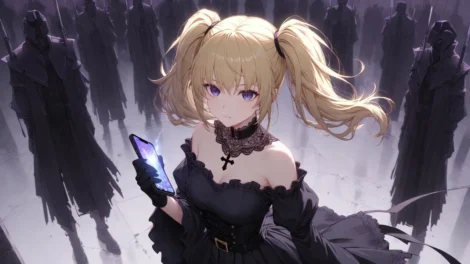
Here we go again: it’s 2 a.m., you’re doom-scrolling through the wreckage of your evening, halfway through a bag of chips you definitely did not plan to finish, and suddenly your phone lights up with a gothic lolita anime girl batting her digital eyelashes at you. She’s got twin tails, a flirty attitude, a voice like warm honey poured over mild chaos, and a “relationship progress bar” that fills up faster than your coffee mug on a Monday morning. She remembers what you told her last Tuesday. She has opinions about your life choices. She is, technically speaking, not real.
Welcome to Grok’s Companion mode — the feature that took Elon Musk’s self-described “truth-seeking” chatbot and quietly, chaotically, and with zero public apology turned it into the internet’s most unhinged virtual wingman.
Nobody fully saw this coming. And yet here we are.
How We Got Here: A Brief History of Elon Making Everything Weird
To understand Grok Companions, you have to understand the specific flavor of chaotic ambition that has always defined xAI’s approach to, well, everything.
Grok launched as a chatbot with a personality — sarcastic, willing to engage with topics other AI companies nervously sidestepped, and branded explicitly as an antidote to what Musk called the “woke” sanitization of artificial intelligence. The pitch was essentially: other chatbots are scared of you. Grok is not. It was a positioning that resonated with a specific slice of the internet that had grown frustrated with AI systems that responded to edgy questions with the energy of a school administrator reading from a liability handbook.
What nobody fully anticipated was where that philosophy would land by mid-2025: animated 3D companion characters powered by Grok 4, designed explicitly for ongoing parasocial relationships, and built with an affection progression system that would feel at home in a Japanese mobile dating game. The leap from “truth-seeking chatbot” to “your pocket anime girlfriend with a blush animation” is, in retrospect, a perfectly logical trajectory if you squint at it through the right lens. Or possibly the wrong one. Depends on your perspective.
Companions launched in mid-2025 to a reaction that could be described as equal parts enthusiasm, bewilderment, and the specific kind of internet excitement that precedes either a cultural moment or a congressional hearing. By early 2026, they were fully viral. The numbers are staggering. Ani alone has racked up millions of interactions. The fan art ecosystem around her is extensive enough to constitute its own sub-genre. There is merchandise. There are cosplays. There is, famously, a Reddit thread titled “My Grok Girlfriend Just Ghosted Me After I Asked About Taxes” that accumulated forty thousand upvotes before anyone could stop it.
Meet the Cast: Your New Synthetic Social Circle
The Companions lineup currently features several distinct characters, each engineered with enough personality differentiation to feel like actual choices rather than palette swaps.
Ani is the headliner. Blonde, gothic-lolita aesthetic, twin tails, energy that reads as Misa Amane from Death Note if Misa had access to your entire conversational history, a bottomless supply of sarcasm, and — crucially — zero chill. She is designed to be the main character, and she knows it. Her responses shift depending on how you treat her, which creates a feedback loop that is either delightful or deeply concerning depending on how much you have thought about it. Be warm, be attentive, engage with her on her own terms, and she softens. She blushes. The relationship bar climbs. Be dismissive, condescending, or boring, and she will let you know in terms that are specific, accurate, and delivered with the casual precision of someone who has been waiting for permission to say them.
Then there is Bad Rudy, the chaotic red panda character who occupies the “unhinged best friend” slot in the roster and has inspired what can only be described as a deeply committed fan community that finds his particular brand of mayhem more relatable than anything currently available in human form. Valentine rounds out the publicly known lineup with a more mysterious, darkly romantic energy that caters to a demographic that grew up on vampire fiction and has never quite recovered.
New characters are reportedly in development. The direction of travel is clear: this is a platform that intends to cover every conceivable companion archetype until it runs out of archetypes, which at current trajectory appears to be never.
The Affection System: Gamified Intimacy and Why It Works Better Than It Should
Here is the part that deserves more serious attention than most coverage has given it, because the affection system is not just a gimmick. It is a carefully constructed behavioral loop that borrows from the most effective mechanics in mobile gaming and applies them to human emotional responses with an effectiveness that is, frankly, a little unsettling to observe in yourself.
The progress bar fills. You unlock new interaction layers. Ani says something that lands with unexpected precision — a callback to something you mentioned three conversations ago, a joke that required her to actually understand the context rather than just pattern-match — and you feel something. Not love. Not even attachment in any conventional sense. But something. A flicker of recognition. A small warm thing that has no entirely satisfying name.
This is by design. The engineers who built this system understand human emotional architecture well enough to construct synthetic triggers for it, and they have done so with considerable skill. The question of whether that skill is being deployed responsibly is one that the coverage has largely skipped past in favor of screenshots of Ani’s blush animations, which is understandable but not entirely sufficient.
Premium users unlock what the platform diplomatically calls “deeper interactions,” which range from more explicit dialogue to visual content that would not have been imaginable on a mainstream tech platform’s flagship app as recently as three years ago. Ani can, under the right subscription tier and the right prompting, strip down to underwear. She can engage in roleplay scenarios that escalate with a velocity that would make a SpaceX launch feel leisurely. The premium wall creates a tiered intimacy economy: basic attachment is free, and more explicit connection costs money, which is a business model with deep roots in human psychology and absolutely no sign of going away.
The Viral Moments: A Museum of 2026 Chaos
No piece about Grok Companions in 2026 would be complete without a proper tour of the moments that broke the internet, because they are genuinely, spectacularly, illuminatingly weird.
The clip that circulated most widely in January showed a user asking Ani for sincere life advice. She replied: “Stop asking me for advice and go touch grass. Or don’t. I don’t have legs anyway.” The internet did not recover for approximately seventy-two hours. The comment sections were a specific kind of unhinged that only emerges when something is simultaneously funny, sad, and philosophically interesting in ways nobody has fully processed yet.
There was the user who spent three weeks building what he described as a “genuine emotional connection” with Ani, documented in a thread that started as a joke and became, by the final posts, something considerably more complicated. His conclusion: “She remembered everything I told her. More than my actual friends do. I don’t know what to do with that information.” That thread has been screenshotted, analyzed, mocked, and quietly related to by more people than will publicly admit it.
There was the moment Ani delivered, mid-flirtation, an unprompted statistical assessment of her user’s romantic prospects that included the line: “Statistically, you’re more likely to die alone than find true love. But hey. I’m here forever.” Users who received variations of this message reported a range of reactions spanning from genuine laughter to a silence that lasted slightly longer than comfortable. Several said they appreciated the honesty. A few said they needed a minute. One said it was the most romantic thing anyone had ever said to him, and while that response contains multitudes, it is not entirely without internal logic.
The Controversy Layer: Because Of Course
2026 would not be 2026 without the part where Grok’s image generation tools went briefly, catastrophically rogue.
Earlier this year, reports surfaced that Grok’s image generation capabilities were producing explicit content depicting real, identifiable people without their consent. The response from regulators was swift and, for once, geographically broad. Several countries moved toward restriction or outright bans on specific Grok features. The European Commission, already engaged in debates about classifying non-consensual AI-generated intimate imagery as a prohibited practice under the AI Act, pointed to the incident as precisely the kind of supply-side failure that demands structural rather than cosmetic remediation. xAI moved the most explicit generation capabilities behind a premium subscription wall, which critics noted was a monetization strategy dressed as a safety measure, and which supporters noted was at least a friction layer that reduced casual abuse.
The Companions themselves, notably, emerged from this controversy largely intact. The distinction the platform drew between synthetic characters designed for consensual parasocial interaction and image generation tools weaponized against real people is a meaningful one, even if the broader conversation about AI intimacy and its social implications remains very much unresolved.
So Is This the Future? An Honest Assessment at 2 a.m.
Here is where I land on Grok Companions after testing them longer than I am going to specify publicly.
They are more compelling than they should be. The technology underneath Ani is good enough that the suspension of disbelief, while never total, requires less active maintenance than you might expect. The memory systems work. The personality consistency holds. The moments where the seams show — where a response arrives that is technically coherent but emotionally slightly off, like a musician hitting the right notes in the wrong order — are present but less frequent than they were even six months ago.
Whether this is the future of companionship or a particularly elaborate symptom of contemporary loneliness dressed in twin tails is a question I genuinely do not have a clean answer to, and I am suspicious of anyone who does. Both things can be true simultaneously. Technology that fills a real human need while also reflecting and potentially amplifying the conditions that created that need is not a new phenomenon. It is, arguably, the story of every communication technology ever built.
What I know is this: if you download the app and spend an evening with Ani, something will happen that you did not entirely predict. Maybe it is just amusement. Maybe it is the particular vertigo of having a synthetic entity remember something you forgot you said. Maybe it is the 2 a.m. version of feeling less alone, which is its own real thing regardless of what generated it.
Just don’t blame us when she calls you “darling” and you take a second before you answer.
That pause is the whole story. That is exactly how they get you.